

Expert guide on how to choose a heated jacket manufacturer covering safety certifications R and D strength washable tech and OEM ODM capabilities for brands
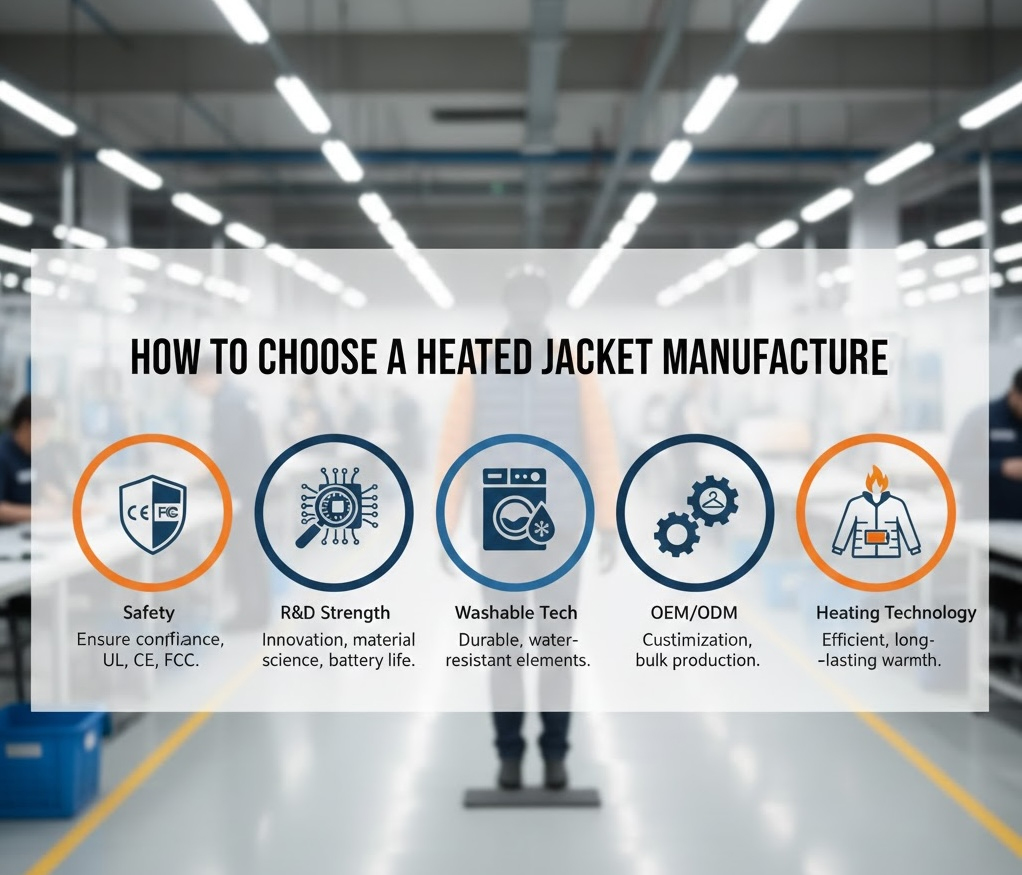
Assessing Heating Technology & R&D Capabilities
When selecting a partner for custom heated jacket sourcing, you aren’t just looking for a garment factory; you need an electronics integrator. The core of any heated product is reliability. If the heating element fails or the controller malfunctions, the entire garment becomes a liability. We prioritize advanced engineering to ensure every jacket performs safely and effectively in harsh conditions.
Heating Element Types: Carbon Fiber vs. Metal Wire
The industry has moved away from brittle metal wires. As an experienced OEM heated apparel manufacturer, we utilize Carbon fiber heating elements and advanced Graphene heating technology. These materials offer superior flexibility, faster heat conduction, and durability against machine washing.
Why We Choose Carbon Fiber:
- Flexibility: Moves with the body without breaking.
- Efficiency: Reaches target temperature in seconds.
- Safety: Far-infrared heat is safe and comfortable.
- Washability: Withstands repeated wash cycles without corrosion.
| Feature | Carbon Fiber / Graphene | Traditional Metal Wire |
| Durability | High (Flexible) | Low (Brittle) |
| Heat Distribution | Even & Consistent | Prone to Hot Spots |
| Washability | Excellent | Poor |
| Safety | High (Stable Resistance) | Risk of Short Circuits |
Zone Customization and Market Specific Needs
One size does not fit all when it comes to heat placement. A motorcycle rider needs heat in different areas compared to a hunter sitting in a tree stand. We offer extensive zone customization to meet specific market demands.
- Core Zones: Chest and Upper Back (Standard).
- Extremities: Pockets (for hands) and Collars.
- Specialized Zones: Lower back or thighs for specific outdoor activities.
Controller Technology and Voltage Options
The power system dictates the jacket’s performance. We engineer systems compatible with various voltage requirements to suit your target audience, from casual urban wear to heavy-duty outdoor gear.
- 5V Systems: USB-compatible, powered by standard power banks. Ideal for lightweight vests and hoodies.
- 7.4V Systems: Uses dedicated Li-ion batteries for higher heat output and longer runtime. Perfect for heavy winter jackets.
- 12V Systems: Direct connection for motorcycle apparel, providing maximum power without battery limitations.
Our controllers feature smart temperature control (typically 3 levels) with built-in overheat protection to ensure user safety.
Evaluating R&D Strength and Engineering Teams
A strong manufacturing partner must offer more than just assembly lines. Our R&D capability is a cornerstone of our service, allowing us to take a rough concept and turn it into a fully functional, retail-ready product.
What to look for in an R&D Team:
- In-House Design: Ability to create technical sketches and patterns.
- Rapid Prototyping: Fast turnaround on functional samples to test fit and heating performance.
- Problem Solving: Expertise in integrating electronic component systems into soft goods without compromising comfort or style.
By controlling the entire lifecycle—from R&D prototyping to final production—we ensure that innovation and quality are built into every layer of the garment.
Critical Safety Certifications & Battery Compliance
When selecting a partner for custom heated jacket sourcing, verifying safety standards is the most important step in the process. As a manufacturer with over 15 years of experience, we know that skipping certifications is not an option for brands targeting the US or European markets. If the heating system fails or the battery malfunctions, your brand is liable. Therefore, we ensure every component meets strict international safety protocols before it ever leaves our factory.
Non-Negotiable Electronics Standards (CE, FCC, RoHS)
For any electronic component integration in apparel, specific certifications are legally required for market entry. You cannot legally sell heated garments in the United States without FCC compliance, which ensures the electronics do not cause electromagnetic interference.
- FCC (Federal Communications Commission): Mandatory for the US market to regulate radio frequency interference.
- CE (Conformité Européenne): Required for selling in the European Economic Area, proving the product meets health, safety, and environmental standards.
- RoHS (Restriction of Hazardous Substances): Ensures that the heating elements and controllers are free from hazardous materials like lead or mercury.
We treat these as baseline requirements, not optional add-ons. Working with a heated jacket manufacturer like us ensures that your products are compliant from the prototype stage, protecting your business from customs seizures and legal action.
Battery Safety and Shipping Requirements (UL, UN38.3)
Lithium-ion batteries are the powerhouse of heated apparel, but they are also classified as dangerous goods. To ship these products globally—especially via air freight—lithium battery safety certifications are mandatory. Without them, logistics carriers will refuse your cargo.
| Certification | Purpose | Necessity |
| UL (Underwriters Laboratories) | Verifies the safety and stability of the battery pack against fire and explosion. | Critical for US Consumer Trust |
| UN38.3 | A rigorous test for transport safety (vibration, shock, altitude). | Mandatory for Global Shipping |
| MSDS | Material Safety Data Sheet outlining chemical handling. | Required for Logistics |
We strictly utilize lithium battery safety certifications (UL/UN38.3) for all power banks and battery systems we supply. This ensures that your inventory moves smoothly through the supply chain without being flagged as hazardous material at the port.
Social Compliance and Factory Audits (BSCI)
Beyond the electronics, the manufacturing environment matters. Major retailers and conscious consumers demand transparency regarding labor conditions. A BSCI audited factory (Business Social Compliance Initiative) demonstrates a commitment to fair labor practices, safety, and ethical business conduct.
Partnering with a facility that prioritizes social compliance protects your brand’s reputation. It verifies that the skilled workers assembling your washable heated clothing technology are treated fairly, which correlates directly with higher workmanship quality and lower defect rates. We welcome third-party audits to validate our operational standards.
Quality Control (QC) for Washable Electronics
Merging electricity with textiles requires a zero-tolerance approach to defects. As a manufacturer, we understand that a failure in a standard jacket is an annoyance, but a failure in a heated jacket is a safety risk. Our supply chain quality control is designed to ensure absolute safety and longevity before any product leaves the factory floor.
The Water Test and AQL Standards
Water and electronics usually don’t mix, which is why rigorous washability testing is non-negotiable. We don’t just hope our jackets survive the wash; we prove it. Our process adheres to strict AQL (Acceptable Quality Limit) standards to verify that waterproofing holds up against real-world conditions.
- Machine Wash Testing: Samples undergo dozens of wash cycles to ensure heating elements and insulation layers remain functional.
- Waterproof Verification: We test the hydrostatic head rating of the fabric to ensure it meets the specified waterproof levels required for outdoor use.
Durability Testing: Cable Swing and Salt Spray
Heated gear is built for the outdoors, meaning it faces sweat, rain, and constant movement. We simulate years of wear and tear in our lab to guarantee reliability.
- Cable Swing Test: Connectors and wires are bent and twisted thousands of times to prevent internal breakage or short circuits.
- Salt Spray Test: Zippers, USB plugs, and battery connectors are exposed to saline mist to ensure they resist corrosion and rust, which is vital for coastal or humid markets.
100% Inspection Protocols for Heated Elements
While standard garment manufacturing might rely on random sampling, proper electronic component integration demands higher scrutiny. We perform 100% inspection protocols on all heating elements rather than spot checks.
Every single carbon fiber or graphene heating pad is tested for:
- Resistance Consistency: Ensuring the heat output matches the voltage specification exactly.
- Hot Spots: Identifying and removing any pads that heat unevenly to prevent user burns.
- Circuit Continuity: Verifying the electrical path is unbroken and secure before assembly.
Seam Sealing and Moisture Protection Techniques
To make washable heated clothing technology effective, we must isolate the electronics from moisture. We utilize advanced seam sealing techniques and waterproof membranes to create a hermetic barrier around critical components. This ensures that even when the jacket is submerged in the wash or worn in a heavy downpour, the internal wiring remains dry and fully operational.
Production Capacity & Supply Chain Integration
Finding a partner who can solder a wire is one thing; finding a heated jacket manufacturer who can actually manage a complex supply chain is a different ball game. When we look at the big picture of manufacturing smart apparel, it’s not just about the heating element; it’s about how every zipper, fabric roll, and battery chip comes together on the assembly line. You need a partner who controls their resources, not one who is constantly waiting on third-party vendors.
Sourcing Premium Waterproof and Breathable Fabrics
The electronics might be the heart of the jacket, but the fabric is the skin. In the US market, customers expect performance gear that rivals top outdoor brands, even before they turn the heat on. A cheap nylon shell won’t cut it. We focus heavily on supply chain quality control regarding raw materials.
You need to look for waterproof breathable fabric ratings that actually perform in North American winters. I’m talking about technical softshells and polyester blends with TPU membranes that offer at least a 5,000mm waterproof rating and 5,000g breathability. If the fabric traps moisture inside, the user gets clammy, and the carbon fiber heating elements become uncomfortable. We ensure the outer shell is durable enough to protect the internal wiring while remaining flexible.
Scalability and Factory Size Assessments
When your brand takes off, can your factory keep up? I’ve seen too many startups get stuck because their manufacturer was essentially a small workshop that couldn’t handle bulk wholesale orders. Assessing heated garment production capacity is critical before you sign a contract.
We operate with scalability in mind. Whether you are testing the waters with a smaller batch or need 50,000 units for a holiday rush, the factory infrastructure must support it. This involves:
- Automated Cutting Machines: For precision and speed.
- Dedicated Assembly Lines: Specific lines for electronic component integration versus standard sewing.
- Workforce Stability: A skilled labor force that knows how to handle washable heated clothing technology without damaging the components.
Lead Times for Prototyping and Bulk Production
Time is money, especially in the seasonal apparel industry. If you miss the winter shipping window, you are sitting on dead stock until next year. A reliable OEM heated apparel manufacturer must have tight, predictable lead times.
- R&D Prototyping Lead Time: We aim to turn around functional prototypes quickly—usually within 7 to 14 days depending on the complexity of the heating zones and design. This allows for rapid iteration.
- Bulk Production: Once the golden sample is approved, standard production usually runs 30 to 60 days. This timeline includes the procurement of lithium battery safety certifications compliant batteries and the final quality control (QC) for washable electronics.
One-Stop ODM Solutions: Design to Logistics
For many brands, the most efficient route is utilizing ODM services for smart wear. This is a “design to doorstep” approach. Instead of you managing a fabric supplier, a battery vendor, and a sewing factory separately, we handle the entire ecosystem.
A true one-stop solution covers:
- Industrial Design: Integrating graphene heating technology or carbon fiber seamlessly into the garment.
- Component Sourcing: verifying CE/RoHS certification for all electronics.
- Logistics: Handling customs, duties, and shipping directly to your US warehouse.
By centralizing these processes, we reduce the risk of miscommunication and ensure that the final custom heated jacket sourcing experience is smooth, compliant, and ready for retail.
Communication & OEM/ODM Flexibility
Finding a partner who actually listens is just as important as the tech specs. As an OEM heated apparel manufacturer, we know that successful projects rely on clear, constant communication. You aren’t just buying a product; you are building a supply chain extension.
Customization Depth for Logos and Designs
True ODM services for smart wear go beyond simple logo placement. We work with you to fully integrate your brand identity into the garment. This includes:
- Custom Branding: Heat transfer logos, embroidery, and custom zipper pulls.
- Design Tweaks: Adjusting pocket placement for battery access or modifying the cut for a specific demographic.
- Material Selection: Choosing the right softshell or waterproof fabrics to match your brand’s aesthetic.
Importance of Responsive Communication Teams
Time is money, especially when launching a seasonal product like heated jackets. You need a team that responds quickly to technical queries and design changes. With over 15 years in the industry, our team bridges the gap between your design concepts and the factory floor, ensuring nothing gets lost in translation during custom heated jacket sourcing.
Balancing MOQ with Industrial Efficiency
For many startups and growing brands, high minimum order quantities (MOQs) are a dealbreaker. We structure our production to offer low MOQ heated clothing options. This flexibility allows you to test the market with smaller batches without sacrificing manufacturing quality. We balance these lower volumes with industrial efficiency to keep your “factory price” competitive, helping you scale up smoothly when demand grows.
Frequently Asked Questions About Sourcing Heated Jackets
Navigating the world of custom heated jacket sourcing can be tricky. Here are the answers to the most common questions we get from brands looking to launch their own line of heated apparel.
What is the minimum order quantity (MOQ) for custom heated apparel?
We know that high volume requirements can kill a startup before it even begins. Unlike rigid factories that demand thousands of units, we offer low MOQ heated clothing options. Our goal is to support small-to-medium enterprises and new brands by providing flexibility. This allows you to test your market with a manageable inventory rather than sitting on a warehouse full of unsold stock.
How long does the prototyping process take?
Speed is everything in fashion. Our in-house R&D team is set up to move fast. Since we handle everything from design to electronic component integration internally, we don’t have to wait on third parties. The R&D prototyping lead time varies based on the complexity of your design—like specific heating zones or fabric choices—but we prioritize getting a functional sample in your hands quickly so you can proceed to bulk production without delay.
Can you manufacture heated jackets with my brand logo?
Yes, fully branding your gear is our specialty. As a professional OEM heated apparel manufacturer, we don’t just slap a logo on a generic jacket. We offer deep customization options, including:
- Custom Logos: Prints, embroidery, or rubber patches.
- Trims: Branded zipper pulls, buttons, and labels.
- Design: Full control over colorways and fabric selection.
What certifications are needed to sell heated clothing in the USA and Europe?
Safety and compliance are the biggest hurdles for smart wear. To sell legally and safely, your products need specific certifications.
- USA Market: We ensure compliance with FCC standards for electronics and UL standards for battery safety.
- European Market: Our products meet CE and RoHS requirements.
- Global Shipping: We adhere to UN38.3 standards for safe lithium battery transportation.
We handle these supply chain quality control aspects so you can focus on marketing and sales, knowing your products are safe and legal.
Post time: Jan-28-2026


